The Quadratic Formula, Solved Step by Step
A quadratic equation has the form ax² + bx + c = 0, where a is not zero. The quadratic formula provides two candidate roots. The symbol ± means calculate one result with plus and a second result with minus.
Worked example · Updated
Calculate the example
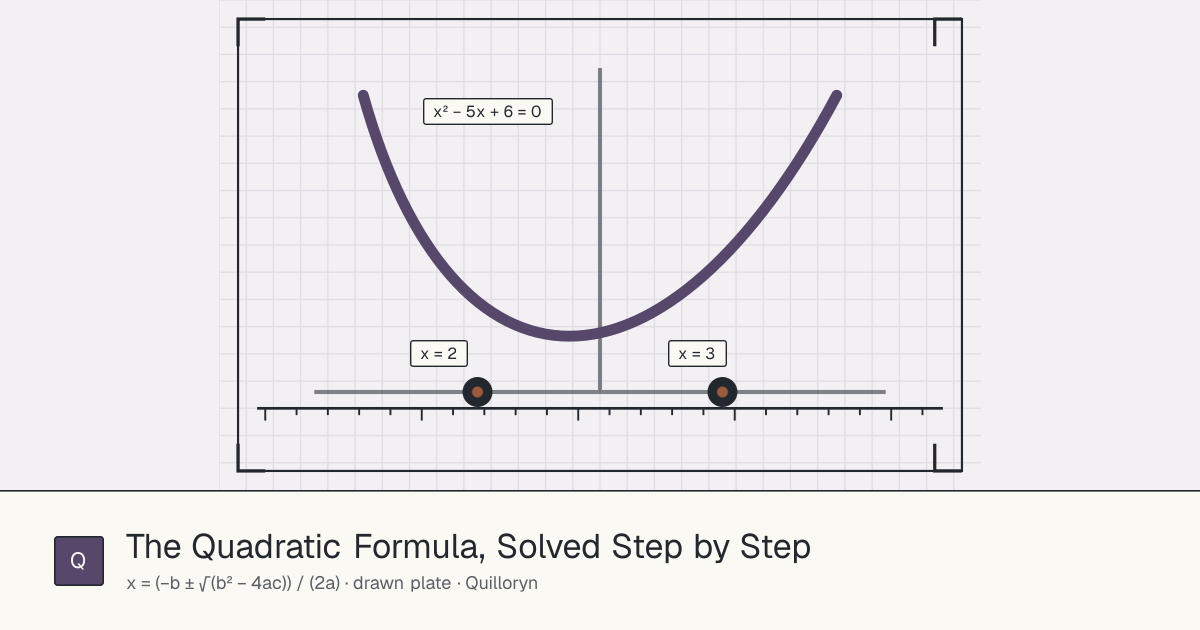
For x² − 5x + 6 = 0, use a = 1, b = −5 and c = 6. The discriminant b² − 4ac is 25 − 24 = 1. The plus branch gives (5 + 1)/2 = 3; the minus branch gives (5 − 1)/2 = 2.
The preset in the formula tool evaluates the plus branch. Change the plus sign to minus to calculate the other root, then press Evaluate to show each result.
Interpret the discriminant
A positive discriminant gives two distinct real roots. A zero discriminant gives one repeated real root. A negative discriminant gives complex roots when the expression tool is configured to handle complex values.
If a = 0, the equation is not quadratic and the formula divides by zero. Check a before applying the formula.
Verify by substitution
Substitute x = 2: 2² − 5(2) + 6 = 0. Substitute x = 3: 3² − 5(3) + 6 = 0. Both results satisfy the original equation.
Verification catches sign errors and helps distinguish a root calculation from a result that merely looks plausible.
| Coefficient / value | Value |
|---|---|
| a | 1 |
| b | −5 |
| c | 6 |
| Discriminant | 1 |
| Minus root | 2 |
| Plus root | 3 |
Continue exploring
Solving Two Linear Equations: Ax = b, Worked
Write two equations as Ax = b, solve a small matrix system and verify both residuals. Open the example in the scientific calculator.
Compound interest: formula, assumptions and worked example
Explore P(1 + r/n)^(nt) with a worked monthly-compounding example. Learn rate conventions and assumptions, then open the formula with values already filled in.