MB vs MiB: Decimal vs Binary Data Sizes Explained
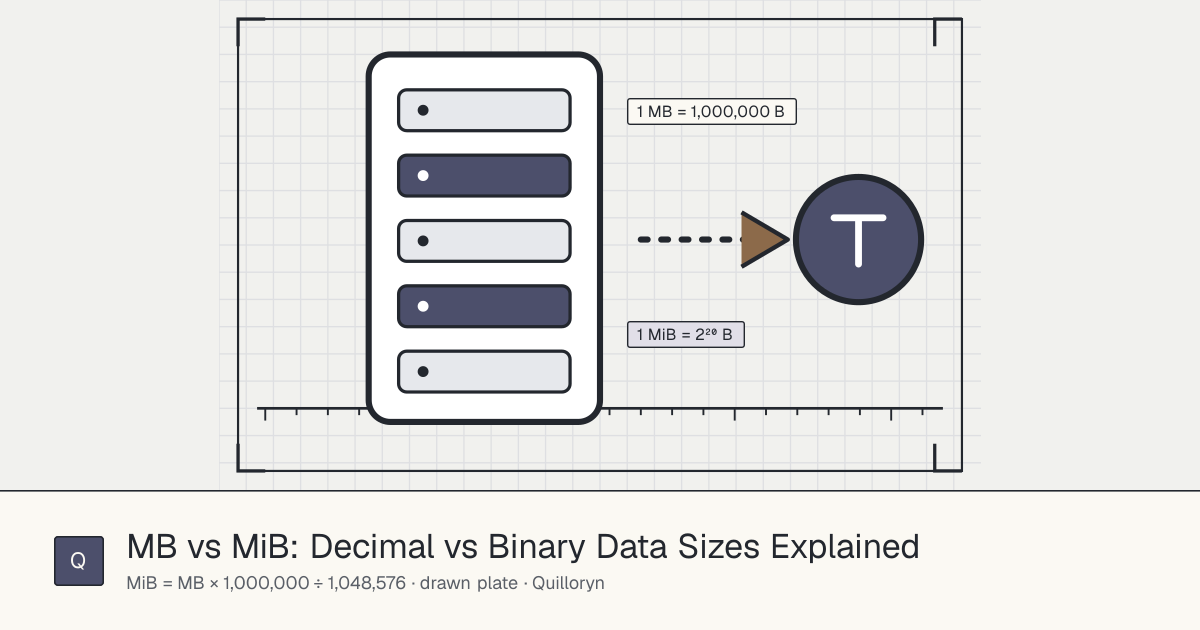
MB and MiB describe different quantities. A megabyte (MB) is 1,000,000 bytes. A mebibyte (MiB) is 1,048,576 bytes, or 2²⁰ bytes. Explicit unit labels avoid treating these two conventions as interchangeable.
Worked example · Updated
Convert between decimal and binary
To convert MB to MiB, multiply by 1,000,000 and divide by 1,048,576. One MB is exactly 0.95367431640625 MiB. In the other direction, one MiB is exactly 1.048576 MB.
For example, 500 MB is approximately 476.837158 MiB. The number changes because the unit size changes, not because any bytes have disappeared.
Keep bits and bytes separate
A byte contains eight bits. Uppercase B means bytes; lowercase b generally means bits. A network rate in megabits per second is not the same as a file size in megabytes, and a transfer-time estimate must also allow for overhead and real throughput.
Check how your device labels capacity
Storage packaging, operating systems and applications do not always use the same convention. Compare the underlying byte count where possible instead of assuming what a displayed abbreviation means.
The data converter labels both conventions explicitly. The linked example is 500 MB to MiB; press Convert to reveal the result.
| Unit | Bytes |
|---|---|
| 1 kB | 1,000 |
| 1 KiB | 1,024 |
| 1 MB | 1,000,000 |
| 1 MiB | 1,048,576 |
| 1 GB | 1,000,000,000 |
| 1 GiB | 1,073,741,824 |
Continue exploring
How to Convert Meters to Feet (Formula & Table)
Convert meters to feet using the exact definition of a foot. Includes a worked 5-meter example, a reference table and a ready-to-use converter.
Solving Two Linear Equations: Ax = b, Worked
Write two equations as Ax = b, solve a small matrix system and verify both residuals. Open the example in the scientific calculator.