Compound interest: formula, assumptions and worked example
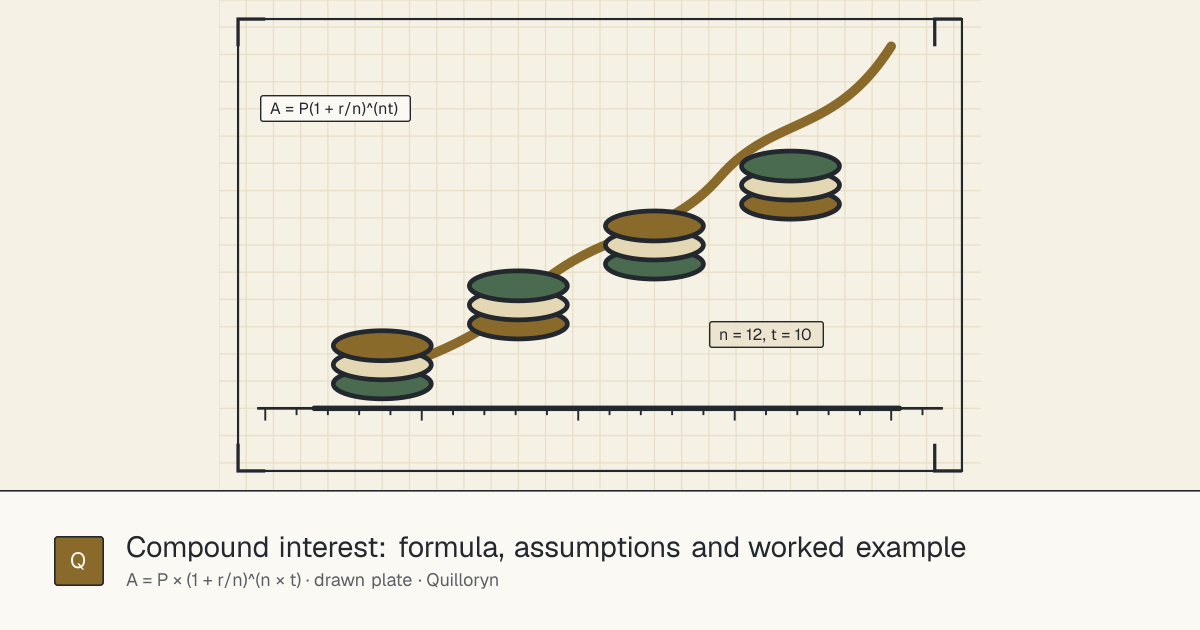
Compound interest adds interest to a balance so future interest is calculated on a larger amount. The expression A = P × (1 + r/n)^(n × t) describes fixed-rate growth with equal compounding periods and no extra deposits or withdrawals.
Worked example · Updated
Define the inputs
P is the starting principal. The nominal annual rate r is written as a decimal, so 5% becomes 0.05. The number n is compounding periods per year, and t is elapsed time in years. Monthly compounding uses n = 12.
Do not substitute an effective annual yield for a nominal annual rate without adjusting the formula. They are different measures.
Work through the illustration
Set P = 1000, r = 0.05, n = 12 and t = 10. The monthly rate is 0.05/12 and there are 120 periods. The calculation gives approximately 1647.00949769, or 1647.01 rounded to two decimal places.
The illustrative increase is the final amount minus the starting principal, about 647.01. This is a mathematical example, not a forecast or a product quote.
What this formula leaves out
Fees, tax, inflation, changing rates, rounding per payment period and additional contributions are not included. The timing of deposits also matters. Use a model that matches the actual schedule for a real decision.
Open the prefilled formula and press Evaluate. Saving is optional; selecting this example does not submit or save anything by itself.
| Symbol | Meaning | Value |
|---|---|---|
| P | Starting principal | 1000 |
| r | Nominal annual rate | 0.05 |
| n | Periods each year | 12 |
| t | Years | 10 |
| A | Illustrative final amount | 1647.01 (rounded) |
Continue exploring
Solving Two Linear Equations: Ax = b, Worked
Write two equations as Ax = b, solve a small matrix system and verify both residuals. Open the example in the scientific calculator.
Currency Reference Rates vs Dealing Rates: Why They Differ
Learn why a currency conversion can differ from a bank or card quote. Understand reference dates, rates, spreads, fees and a simple worked illustration.