Celsius to Fahrenheit: °C to °F Formula & Examples
Temperature scales have different zero points as well as different step sizes. That is why converting a Celsius temperature to Fahrenheit requires both multiplication and an offset, rather than a single conversion factor.
Worked example · Updated
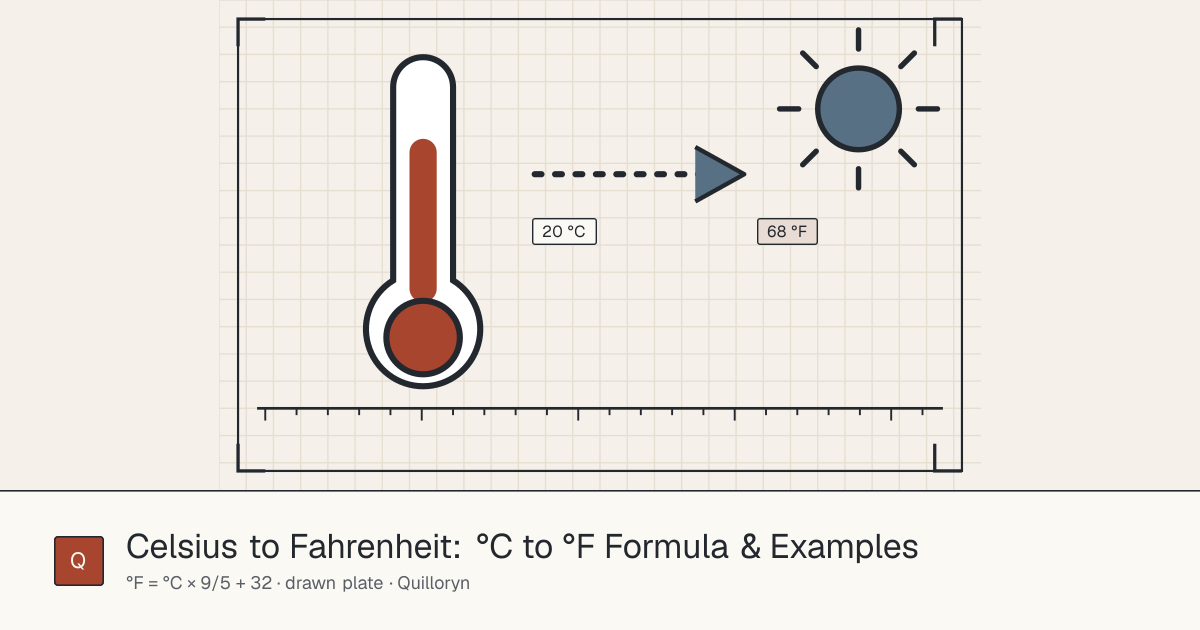
Convert 20 °C step by step
Multiply 20 by 9/5 to obtain 36. Add 32, giving 68 °F. For the reverse direction, subtract 32 from Fahrenheit first, then multiply by 5/9. Thus (68 − 32) × 5/9 returns 20 °C.
A temperature change is different
For a change or difference in temperature, do not add 32. A rise of 10 Celsius degrees is a rise of 18 Fahrenheit degrees. The offset is only needed when converting an actual temperature reading.
Celsius to kelvin uses K = °C + 273.15. In ordinary thermodynamic use, a temperature below 0 K is not physically valid. Check the meaning of the reading before using a result.
Convert a reading
Open the converter, enter the reading, choose Celsius and Fahrenheit, and press Convert. The initial example is 20 °C. You can swap the scales to check the reverse calculation.
Numerical conversion does not account for sensor calibration, uncertainty or a safety limit. Those require information about the particular instrument and situation.
| Celsius | Fahrenheit |
|---|---|
| −40 °C | −40 °F |
| 0 °C | 32 °F |
| 20 °C | 68 °F |
| 37 °C | 98.6 °F |
| 100 °C | 212 °F |
Continue exploring
How to Convert Meters to Feet (Formula & Table)
Convert meters to feet using the exact definition of a foot. Includes a worked 5-meter example, a reference table and a ready-to-use converter.
LBS to KG: Pounds to Kilograms Formula & Table
Convert pounds to kilograms with the exact factor 0.45359237. Follow a 10-pound example and use the prefilled mass converter.